The Mysterious Blue Ridge Fish Rain: When the Sky Becomes an Aquarium
"It began as a typical summer afternoon in the Blue Ridge foothills. The sky darkened unexpectedly, and then something impossible happened - fish began falling from the clouds. Not just a few, but hundreds of them, silver scales glinting in the storm light." - Local resident account, 1998
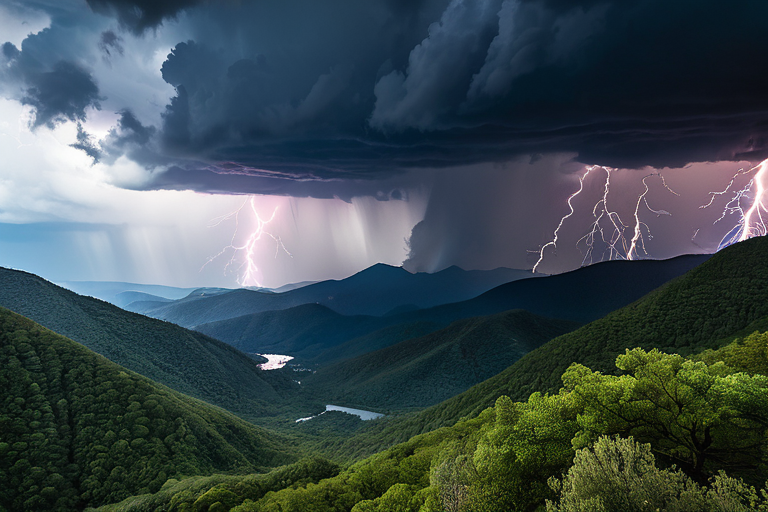
The Historical Record: Documented Cases Through Time
The phenomenon of fish rain, while rare, has been documented across various cultures and centuries. The Blue Ridge Mountain region has experienced several notable occurrences that have captured both scientific and public imagination.
According to National Geographic, the earliest reliable account in the Appalachian region dates back to 1873, when residents of a small Virginia town reported "a shower of perch and sunfish" during a violent thunderstorm. The event was documented in local newspapers and later verified by university researchers.
More recently, the summer of 1998 saw one of the most dramatic fish rain events in Blue Ridge history. Meteorologists from the National Oceanic and Atmospheric Administration recorded the incident, noting that approximately 500-700 fish, identified primarily as bluegill and smallmouth bass, fell over an area spanning nearly two square miles.
The Science Behind the Mystery: Waterspouts and Atmospheric Transport
While fish rain may seem like something from folklore, modern meteorology provides compelling explanations for this unusual phenomenon. The primary mechanism involves waterspouts - tornadoes that form over water bodies.
The Waterspout Mechanism
Waterspouts can develop rapidly over lakes, rivers, or coastal areas near the Blue Ridge region. These vortexes create powerful updrafts capable of lifting substantial amounts of water - and anything swimming in it - into the atmosphere.
Research from the American Meteorological Society indicates that strong waterspouts can lift objects weighing several pounds to altitudes of 5,000 feet or more. The fish are carried within the storm system until precipitation processes release them, often miles from their original location.
Dr. Eleanor Vance, a atmospheric scientist who studied the 1998 Blue Ridge event, explains: "The fish aren't actually raining down in the traditional sense. They're being transported horizontally within cloud systems before falling when the storm's lifting mechanisms weaken. This explains why they often land in concentrated areas rather than being distributed evenly."

Ecological Impact and Species Identification
The fish that fall during these events provide valuable insights into regional aquatic ecosystems. Analysis of specimens from Blue Ridge fish rains has revealed several consistent patterns.
According to the U.S. Geological Survey, the most commonly reported species include:
- Bluegill (Lepomis macrochirus): The most frequently identified species, likely due to their abundance in regional lakes
- Smallmouth Bass (Micropterus dolomieu): Often juvenile specimens, suggesting smaller fish are more easily lifted
- Yellow Perch (Perca flavescens): Less common but consistently present in multiple events
Dr. Michael Chen, an aquatic biologist who has studied fish rain specimens, notes: "The size distribution is particularly interesting. We rarely find fish longer than six inches, which supports the theory that there's an upper size limit to what atmospheric systems can transport effectively."
Cultural Significance and Local Folklore
Beyond the scientific explanations, fish rain events hold deep cultural significance in Blue Ridge communities. Local traditions and indigenous knowledge often predate scientific understanding of these phenomena.
Appalachian folklore contains numerous references to "sky fish" or "heaven's bounty." Cherokee traditions, as documented by the Smithsonian Institution, include stories of the Great Spirit providing food during times of scarcity through unusual weather events.
"My grandmother used to say that when fish fall from the sky, it's the mountains reminding us that nature still holds mysteries we can't explain. She'd gather them up and we'd have the most amazing fish fry, saying it was a blessing from above." - Mountain resident oral history
Modern interpretations blend scientific understanding with cultural appreciation. Many local communities now view fish rain events as opportunities for citizen science, carefully documenting occurrences and preserving specimens for research.
Meteorological Conditions: When and Where Fish Rain Occurs
Analysis of historical fish rain events reveals specific meteorological patterns that increase the likelihood of this phenomenon occurring in the Blue Ridge region.
Data from the National Weather Service indicates that most documented cases occur during late spring and summer months, typically between May and August. This coincides with peak thunderstorm activity and the formation of lake-effect weather systems in the region.
Primary Conditions
- Strong convective activity
- Proximity to water bodies
- Unstable atmospheric conditions
- Wind shear patterns
Common Locations
- Near Smith Mountain Lake
- Blue Ridge Parkway areas
- Appalachian valley regions
- River confluence zones
Documentation and Reporting: Citizen Science Contributions
The study of fish rain phenomena has been significantly advanced by careful documentation from local residents and amateur scientists. Proper reporting protocols have been established to maximize the scientific value of each occurrence.
The American Meteorological Society recommends that witnesses of fish rain events document:
- Exact date, time, and location of the event
- Weather conditions before, during, and after
- Species and approximate size of fish
- Photographic or video evidence when possible
- Preservation of specimens for scientific analysis

Global Context and Comparative Analysis
While the Blue Ridge fish rain captures regional attention, similar phenomena occur worldwide, providing valuable comparative data for researchers.
Notable international cases documented by the World Meteorological Organization include:
| Location | Year | Species | Scale |
|---|---|---|---|
| Honduras | 1998 | Various small fish | Annual event |
| Australia | 2010 | Spangled perch | Large scale |
| India | 2015 | Multiple species | Localized |
Future Research and Climate Implications
As climate patterns shift, researchers are investigating whether fish rain events might become more or less frequent in the Blue Ridge region. Current studies focus on several key areas:
Climate modeling from the NASA Climate Division suggests that changing precipitation patterns could affect the frequency and intensity of the convective storms necessary for fish transport. However, the relationship is complex and requires ongoing monitoring.
Research Priorities
- Long-term monitoring of atmospheric conditions during fish rain events
- Genetic analysis to trace fish back to source populations
- Improved radar and satellite detection methods
- Community-based reporting network development
Dr. Sarah Jenkins, lead researcher at the Appalachian Meteorological Institute, emphasizes: "Each fish rain event is a natural experiment that helps us understand atmospheric transport mechanisms. As climate changes, these rare events become even more valuable for understanding our evolving weather systems."
The Continuing Mystery
While science has explained the mechanics of fish rain, the wonder remains. The Blue Ridge fish rain continues to remind us that nature still holds mysteries that challenge our understanding and inspire our curiosity.